Pearson Edexcel · A-Level · Mathematics
Course version: 9MA0 · Version from Mar 2026
Manipulate polynomials algebraically, including expanding brackets and…
Full specification wording
Algebra and functions: 2.6 Manipulate polynomials algebraically, including expanding brackets and collecting like terms, factorisation and simple algebraic division; use of the factor theorem. Simplify rational expressions, including by factorising and cancelling, and algebraic division (by linear expressions only).
Polynomial manipulation covers expanding products such as (x + 2)(x² − 3x + 1) and collecting like terms, factorising by common factors and by inspection, and dividing a polynomial by a linear…
Checked against the Pearson Edexcel 9MA0 specification (opens in a new tab) on .
- Point 6 of 11
- 4 key terms
Study notes
From the checked teaching notes for this specification point.
The idea
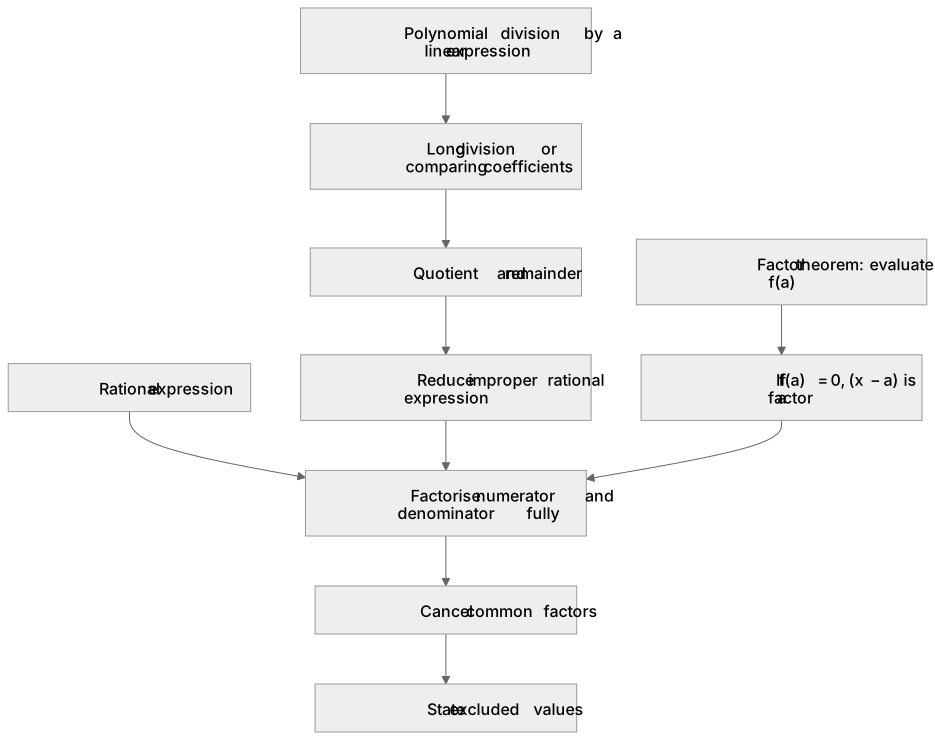
Polynomial manipulation covers expanding products such as (x + 2)(x² − 3x + 1) and collecting like terms, factorising by common factors and by inspection, and dividing a polynomial by a linear expression. Simple algebraic division may be done by long division or by comparing coefficients. The factor theorem states that (x − a) is a factor of f(x) exactly when f(a) = 0, so substituting a candidate value tests for a factor and helps to factorise fully. Rational expressions are simplified by factorising numerator and denominator completely, then cancelling common factors, remembering that the cancelled factor must not be zero. Division by a linear expression can also reduce an improper rational expression before further simplification.
What earns the marks
- Expands products of brackets correctly and collects like terms to give a simplified polynomial.
- Factorises polynomials using common factors, the factor theorem and, where possible, inspection of quadratic factors.
- Applies the factor theorem by evaluating f(a) and concluding whether (x − a) is a factor.
- Divides a polynomial by a linear expression, by long division or by comparing coefficients, and states the quotient and remainder correctly.
- Simplifies a rational expression by factorising fully and cancelling common factors, stating any excluded values.
Common mistakes and how to put them right
Cancelling terms rather than factors, such as removing x from a sum.
Put it right by factorising first and cancelling only whole common factors.
Sign errors when substituting a negative value into the factor theorem.
Put it right by evaluating carefully, for example f(−2) means substituting x = −2 throughout.
Leaving a remainder unrecorded after algebraic division.
Put it right by writing the result as quotient plus remainder over the divisor.
Exam tips
- Show the factor theorem substitution explicitly, including the value of f(a), to justify the conclusion.
- When simplifying a rational expression, factorise both parts fully before cancelling anything.
- Check a division by multiplying the quotient by the divisor and adding the remainder.
Try the lesson
The start of the Algebra and functions: 2.6 Manipulate polynomials algebraically, including expanding brackets and collecting like terms, factorisation and simple algebraic division; use of the factor theorem. Simplify rational expressions, including by factorising and cancelling, and algebraic division (by linear expressions only). lesson, made from checked teaching notes for this specification point.
Have a go first
Expand and simplify (2x - 1)(x² + 4x - 3).
Listen
Polynomial manipulation covers expanding products such as (x + 2)(x² − 3x + 1) and collecting like terms, factorising by common factors and by inspection, and dividing a polynomial by a linear expression. Simple algebraic division may be done by long division or by comparing coefficients. The factor theorem states that (x − a) is a factor of f(x) exactly when f(a) = 0, so substituting a candidate value tests for a factor and helps to factorise fully. Rational expressions are simplified by factorising numerator and denominator completely, then cancelling common factors, remembering that the cancelled factor must not be zero. Division by a linear expression can also reduce an improper rational expression before further simplification. A strong answer earns marks for these points. Expands products of brackets correctly and collects like terms to give a simplified polynomial. Factorises polynomials using common factors, the factor theorem and, where possible, inspection of quadratic factors. Applies the factor theorem by evaluating f(a) and concluding whether (x − a) is a factor. Divides a polynomial by a linear expression, by long division or by comparing coefficients, and states the quotient and remainder correctly. A common slip: Cancelling terms rather than factors, such as removing x from a sum. Instead, factorising first and cancelling only whole common factors. Exam tip: Show the factor theorem substitution explicitly, including the value of f(a), to justify the conclusion.
See it
Key words
Say what each word means before you turn the card.
Expanding and collecting like terms
Try answering aloud or in your head before turning the card.
Factor theorem
Try answering aloud or in your head before turning the card.
Algebraic division by linear expressions
Try answering aloud or in your head before turning the card.
Simplifying rational expressions
Try answering aloud or in your head before turning the card.
See every definition
- Expanding and collecting like terms
- Multiplying out products of brackets and gathering like terms to give a simplified polynomial.
- Factor theorem
- States that (x − a) is a factor of f(x) exactly when f(a) = 0, so substituting a candidate value tests for a factor.
- Algebraic division by linear expressions
- Dividing a polynomial by a linear expression by long division or by comparing coefficients, stating the quotient and remainder correctly.
- Simplifying rational expressions
- Factorising numerator and denominator completely, then cancelling common factors, remembering that the cancelled factor must not be zero.
Label the diagram
Some boxes have lost their names. Pick the right name for each number.
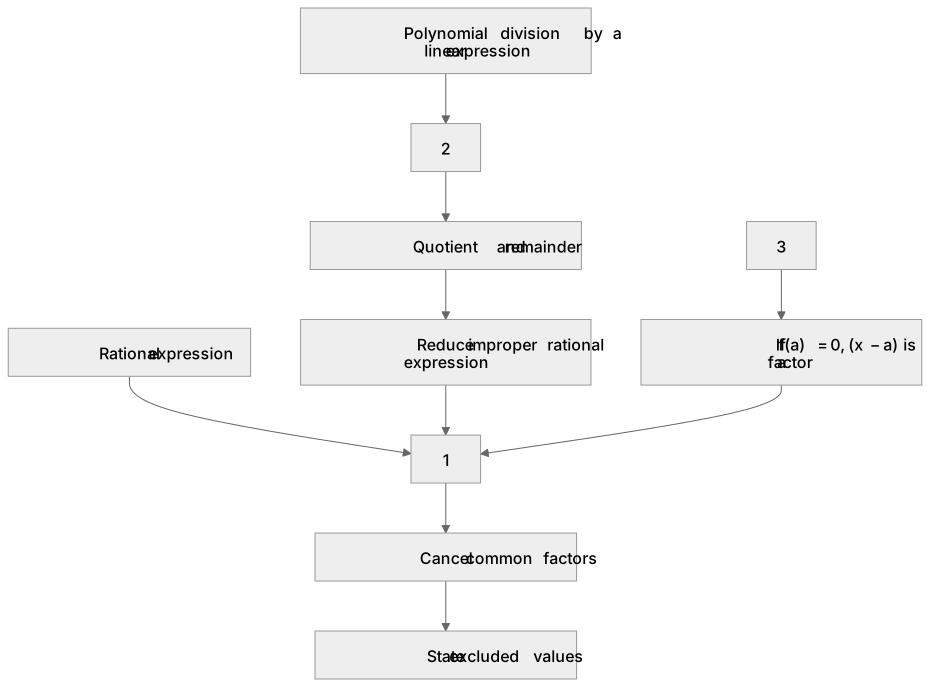
1Box 1
2Box 2
3Box 3
There is more to this lesson
The full lesson goes on to check your understanding and help you earn the marks. Create a free account to carry on, with your progress saved.
A week of Premium from your first lesson · Then the free plan continues · No card, no charge
Test your understanding of Algebra and functions: 2.6 Manipulate polynomials algebraically, including expanding brackets and collecting like terms, factorisation and simple algebraic division; use of the factor theorem. Simplify rational expressions, including by factorising and cancelling, and algebraic division (by linear expressions only).
Active recall beats re-reading. Take an instant quiz now to test what you’ve learned and lock it into long-term memory.
A week of Premium from your first lesson · Then the free plan continues · No card, no charge